The Court of Appeals of Indiana held that a pastor could not sue the church that formerly employed him for wages and vacation pay, concluding that the lawsuit would require the court to inquire into intrachurch matters, which the court reasoned is forbidden by the First Amendment. In Steven Matthies v. The First Presbyterian Church of Greensburg Indiana, Inc., No. 16A01-1409-PL-380 (Ind. Ct. App. Apr. 8, 2015), Pastor Steven Matthies sought to enforce part of a three-year contract that he argued entitled him to salary and vacation pay after his employment ended.

Informing faith communities and their leaders about legal issues.
Wednesday, April 8, 2015


Tuesday, March 10, 2015
7th Circuit: Milwaukee Archdiocese’s cemetery trust fund not off limits from sex-abuse victims in bankruptcy court
In the
latest opinion interpreting the federal Religious Freedom Restoration Act
(RFRA), the Seventh Circuit concluded that the 1993 law does not require the
court to exclude a $55 million cemetery trust fund from the Archdiocese of
Milwaukee’s bankruptcy estate. The case, Listecki v. Official Committee of Unsecured Creditors,
involves the question of whether a 2008 transfer of the money from the
archdiocese’s general fund to a newly created trust.
Monday, December 22, 2014
Who should adopt minutes for an annual members' meeting?
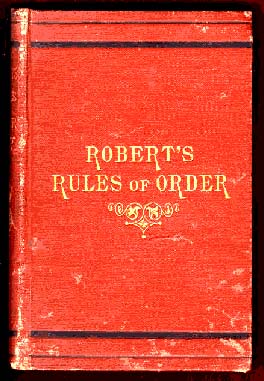 When a religious organization holds large annual meetings, the method of approving the minutes can vary depending on the organization’s governing documents. But where those documents don’t address the question, the answer can be a little difficult to find. The best answer is to delegate the authority to adopt minutes to a committee to avoid a long interim without an adopted record of actions taken. The next annual meeting can revise if necessary.
Tuesday, December 16, 2014
Ex Officio Committee Members
Committees with ex officio members should include those
people in their notices of meetings, but when someone is a member ex officio of
all committees, the ex officio member is not
counted when determining a quorum. (Typically, this is the president, but in
the model constitution, this is the president and senior pastor.) These ex officio
members are only different from regular members in their obligation to attend
committee meetings. In other words, they have all the privileges of a member,
but they are usually exempted from the responsibilities. On the other hand,
when someone is an ex officio of a specific committee, that person has all the
rights and obligations of another member, so the only difference is the method
of selection (member due to office rather than other means of selection).
Monday, December 8, 2014
Considerations when offered a planned gift
You’ve just received word that one of your long-time donors has decided to leave a large gift, but it’s in the form of a planned gift. It might be as simple as naming your organization in the donor’s will. Or it might be a more complex mechanism like a trust or an annuity. One of the questions you need to keep in mind is what happens if your group ceases to exist or changes its name. While the default legal rule is that any reference to your organization will be treated as referring to the group’s successor, there are situations in which that is not true. And thinking about the possibility at the time of the gift can save a lot of trouble later.
Monday, December 1, 2014
Seventh Circuit dismisses appeal, allowing Catholic teacher's in vitro fertilization suit to go forward
This post is being published on both Law Meets Gospel and Indiana Education Law Blog.
The Roman Catholic Diocese of Fort Wayne–South Bend’s appeal from an order denying summary judgment in a lawsuit brought by a former teacher suing the diocese for firing her because she became pregnant through in vitro fertilization was dismissed by a decision. In the unanimous decision written by Judge Diane S. Sykes, the Seventh Circuit held that the appeal was filed too early because the summary-judgment order was not final.
The Roman Catholic Diocese of Fort Wayne–South Bend’s appeal from an order denying summary judgment in a lawsuit brought by a former teacher suing the diocese for firing her because she became pregnant through in vitro fertilization was dismissed by a decision. In the unanimous decision written by Judge Diane S. Sykes, the Seventh Circuit held that the appeal was filed too early because the summary-judgment order was not final.
Thursday, November 20, 2014
What to do when hiring a person with DACA status
One of the biggest postelection debates in Washington surrounds President Obama’s legal authority to grant of legal status to undocumented immigrants. The discussion is the latest chapter in a series of events that included the Obama administration issuing in 2012 what has become known as the Deferred Action for Childhood Arrivals (DACA). DACA gave legal status to certain undocumented immigrants who were under thirty-one on June 15, 2012. Although the current debate is about expanding a similar status to others, which President Obama seems set to announce, this post covers the basics of DACA for the purpose of churches and other religious organizations hiring someone with DACA status. Specifically, it addresses which tax and other forms organizations first hiring someone with DACA status to use. In other words, it answers the questions whether someone who falls under DACA qualifies as an Other U.S. person as defined by form W-9 and,
if so, whether that person would need to meet other requirements or fill out
other forms.
The answer to the first question is yes: an
individual with DACA status meets the definition of U.S.
person for tax purposes because the person is almost certainly a resident
alien under tax law. This is because DACA status requires criteria that
necessarily would mean the individual would meet the substantial-presence test.
The answer to the second question is not for the W-9.
All the W-9 requires is the sworn statement that the signatory is a U.S.
person. But there are other items that employers need to take care of,
including Form
I-9 from U.S. Citizenship and Immigration Services.
Subscribe to:
Posts (Atom)